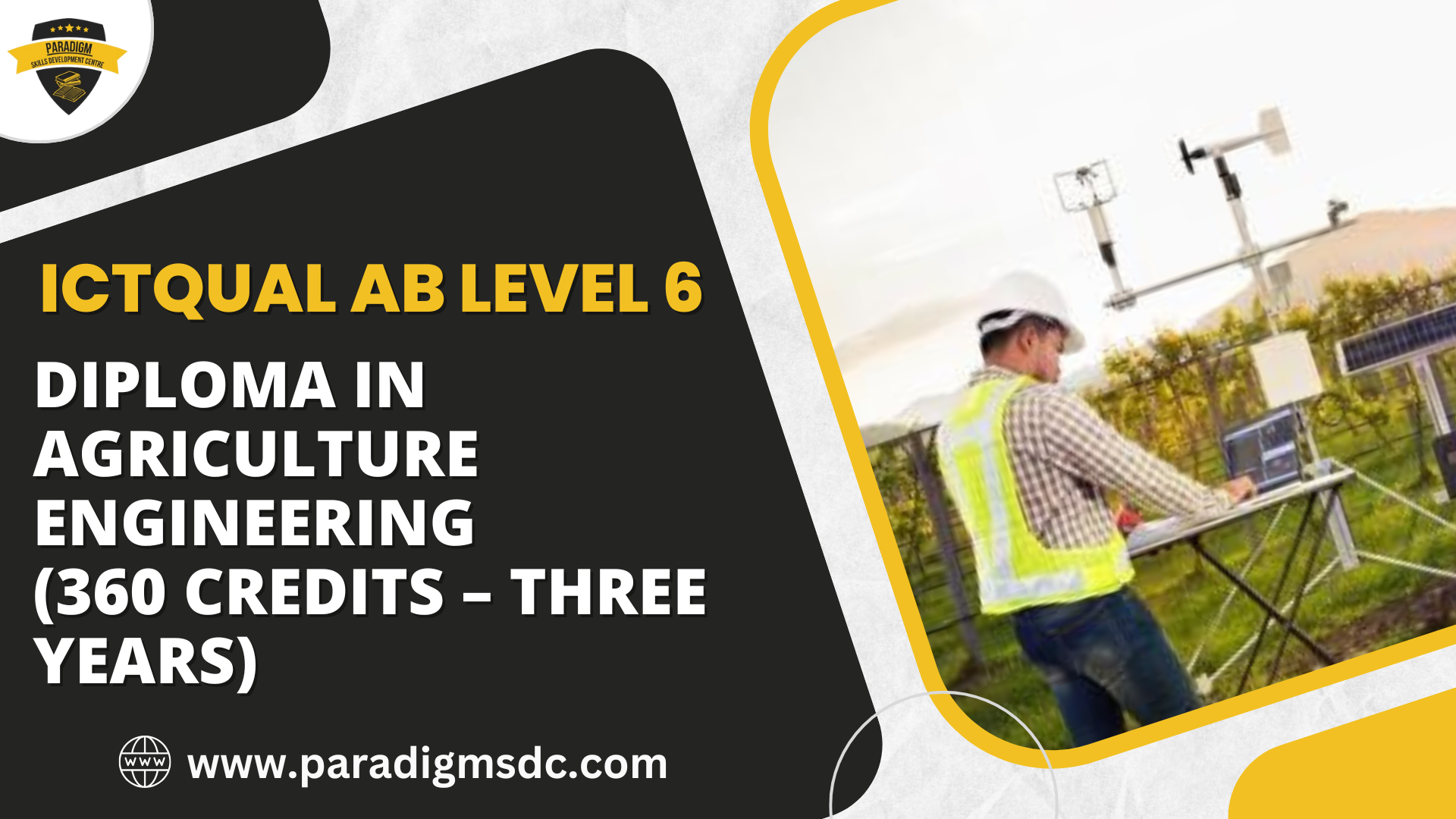
Agriculture is rapidly transforming with the integration of engineering, technology, and sustainability, creating a growing demand for professionals who can design and implement advanced farming solutions. The ICTQual Level 6 Diploma in Agriculture Engineering (360 Credits – Three Years) is a comprehensive qualification that equips learners with the knowledge and skills to meet this demand.
This diploma combines theoretical knowledge with hands-on training, covering areas such as farm machinery, irrigation systems, precision agriculture, renewable energy applications, and sustainable farming practices. Over three years, students will gain a strong foundation in engineering principles while applying them to real-world agricultural challenges.
Graduates of this programme will be well-prepared to take on roles in farm management, agricultural machinery design, irrigation system development, renewable energy integration, and agri-tech innovation. With agriculture becoming increasingly technology-driven, this qualification opens doors to diverse opportunities in industry, research, and entrepreneurship.
Entry Requirements
To enrol in the ICTQual Level 6 Diploma in Agriculture Engineering (360 Credits – Three Years), candidates must meet the following criteria:
- Minimum Age: 18 years old.
- Academic Qualifications: A Level 5 qualification (or equivalent) in engineering, technology, agriculture, or related technical fields. Alternatively, A-levels (or equivalent) including Mathematics and English.
- Interest and Motivation: Demonstrated passion for agriculture and engineering (personal statement or interview may be required).
- Experience: While not mandatory, prior experience in agriculture, mechanics, or engineering is advantageous.
- English Proficiency: Non-native speakers may be required to provide proof of English proficiency (e.g., IELTS or equivalent).
Programme Structure
The diploma consists of 36 mandatory units, spread across three years, ensuring both foundational knowledge and advanced technical expertise.
Year 1 – Foundational Knowledge
- Introduction to Agricultural Engineering
- Basics of Soil Science
- Plant Science and Crop Physiology
- Introduction to Farm Machinery
- Principles of Irrigation and Drainage
- Environmental Science in Agriculture
- Mathematics for Engineers
- Fundamentals of Agricultural Economics
- Renewable Energy in Agriculture (Basics)
- Agricultural Chemistry
- Engineering Drawing and CAD
- Workshop Practices in Agricultural Engineering
Year 2 – Intermediate Concepts and Applications
- Advanced Soil and Water Management
- Farm Power and Mechanization
- Agricultural Structures and Materials
- Irrigation Systems Design
- Introduction to Precision Agriculture
- Agricultural Waste Management
- Crop Protection Technologies
- Advanced Farm Machinery Operations
- Agro-Processing Principles
- Renewable Energy Technologies in Agriculture
- Land Surveying and Mapping
- Practical Training in Agricultural Engineering
Year 3 – Advanced Studies and Specialisation
- Sustainable Agriculture Practices
- Advanced Irrigation and Drainage Engineering
- Farm Business Management
- Design of Agricultural Machinery
- Precision Farming Systems
- Advanced Soil Mechanics
- Climate-Smart Agriculture
- Renewable Energy Systems for Farms
- Post-Harvest Technology
- Automation in Agriculture
- Research Methods in Agricultural Engineering
- Final Project in Agricultural Engineering
Career Progression Opportunities
Graduates of the ICTQual Level 6 Diploma in Agriculture Engineering will be well-equipped for a variety of professional pathways:
1. Professional Certifications and Accreditation
- Chartered Engineer (CEng) through professional bodies such as IAgrE.
- Certifications in irrigation systems, renewable energy, or precision agriculture.
2. Career Advancement
- Agricultural Engineer – Design and optimize machinery, equipment, and systems.
- Farm Management Consultant – Advise on technology integration and resource optimization.
- Sustainability Manager – Focus on renewable energy, waste management, and climate-smart farming.
- R&D Specialist – Develop innovative technologies for sustainable agriculture.
3. Entrepreneurship and Agri-Tech Innovation
- Start businesses in precision farming, agricultural machinery manufacturing, renewable energy solutions, or agri-tech software development.
- Establish consultancy services for sustainable agriculture and engineering practices.
4. Industry Leadership Roles
- Project Manager in large-scale agricultural projects.
- Policy and Advocacy Specialist, shaping agricultural innovation and sustainability policies.
5. Global Opportunities
- Work internationally in regions modernizing their farming practices.
- Collaborate with NGOs and global agencies to address food security and sustainable development.